A clearer plan for the final site walk.
Use this guide to prepare an area-by-area inspection, gather handover documents and record unfinished work and defects. Check your contract for the requirements that apply to your project.
Built for builders, site supervisors, and project managers preparing a project for practical completion inspection and handover.
Walk the inspection area by area and capture every defect with photos, location, and trade.
Assemble the handover documentation while the defect list is being rectified, not after.
Verify rectification and hand over a closed, evidenced defect report with the certificate.
The inspection walk, area by area
The practical completion inspection is a systematic walk of the works, not a scan for obvious problems. Cover every area against the contract scope and record each item as a structured defect, not a margin note.
- External works: roofing, cladding, render and paint, windows and glazing, balconies, drainage, driveways, and landscaping within scope.
- Internal finishes: walls, ceilings, cornices, paint, doors, hardware, skirtings, flooring, tiling, and cabinetry in every room.
- Wet areas: waterproofing junctions, tile falls, silicone, tapware, shower screens, and fixture operation.
- Services and commissioning: electrical fit-off, switching, plumbing operation, HVAC commissioning, smoke alarms, and any required test results.
The documentation side of practical completion
The certificate does not issue on a tidy site alone. Most contracts require a documentation package alongside the physical works, and chasing it in the final week is how handover dates slip.
- Certificates of compliance for electrical, plumbing, glazing, waterproofing, and other regulated work.
- Warranties and product documentation from subcontractors and suppliers.
- Operation and maintenance manuals, keys, remotes, and access credentials.
- As-built drawings and any occupancy or completion approvals the contract requires.
The defect list is the working half of the checklist
Minor defects do not usually prevent practical completion, but they must be recorded, assigned, and closed. The PC defect list is where most of the checklist effort actually lands.
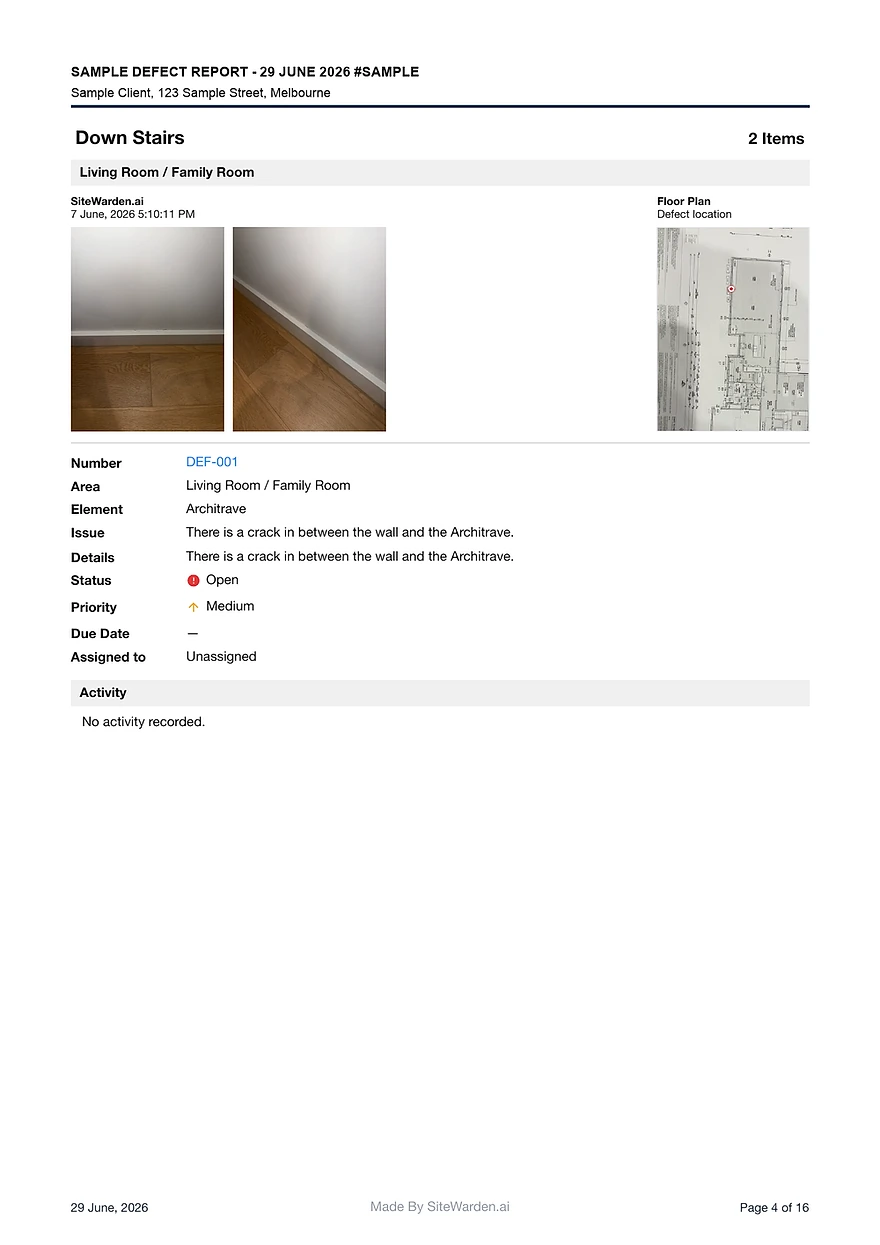
- Capture every item found on the walk with photos, location, element, trade, and priority.
- Assign each defect to the responsible contractor with a completion expectation.
- Verify rectification before marking items closed — the client walk will check.
- Keep the closed list as the record of the works’ condition at handover.
From checklist to evidence
A ticked checklist proves someone walked the site. A defect record with photos, assignments, and verification proves the condition of the works — which is what matters during the defect liability period.
- SiteWarden captures the walk as structured defect records with photos, voice notes, and floor-plan pins.
- Contractor rectification and verification happen against the same records.
- The handover report is generated from the closed list, not rebuilt in a document.
What should a practical completion checklist include?
An area-by-area inspection of external works, internal finishes, wet areas, and services, plus the documentation package: compliance certificates, warranties, manuals, as-builts, and keys, and a recorded defect list with rectification and verification.
Do minor defects prevent practical completion?
Usually not. Most Australian contracts define practical completion as the works being complete except for minor defects that do not prevent use. Those minor defects still need to be listed, rectified, and closed out.
Who runs the practical completion inspection?
The builder walks the works first and closes what it finds, then the superintendent, architect, or client representative inspects and issues or withholds the certificate. A clean builder-side walk shortens the client-side list.
How is the PC defect list different from the checklist?
The checklist is the plan for the inspection and handover package. The defect list is the live output of the walk — every recorded item with its photos, contractor, status, and verification.
Can I use SiteWarden for punch lists and defects?
Yes. Use project lists to record work that needs finishing or fixing, with photos, locations, trades, priorities and statuses. The current app labels these records as defects; the same record can describe unfinished work or an issue that needs repair.
How do contractors take part?
Your team assigns responsibility and controls review and approval. Contractor replies through WhatsApp are forthcoming and are not included in the current trial. In that planned workflow, contractors will send photos, voice notes and progress updates without a SiteWarden account; the builder will still approve the work.
Bring your list.
We’ll walk you through it.
Unfinished work, defects and the details in between. See how the current app captures, organises and reports on them.